
Google AI Overviews are coming to France: why this is a leadership topic (not a minor SEO detail)
For years, SEO was a “comfortable” playing field. You published, you optimized, you gained positions, and you captured traffic. The game was readable: blue links, a ranking, a battle of intent.
Google AI Overviews change that grammar. Not tomorrow, but already today, and in many countries already. If France has been slower, it is not an exemption. It is a window.
A short window, especially for those steering a business under growing pressure on acquisition, with a small voice in the background: “What if we miss the turn?”
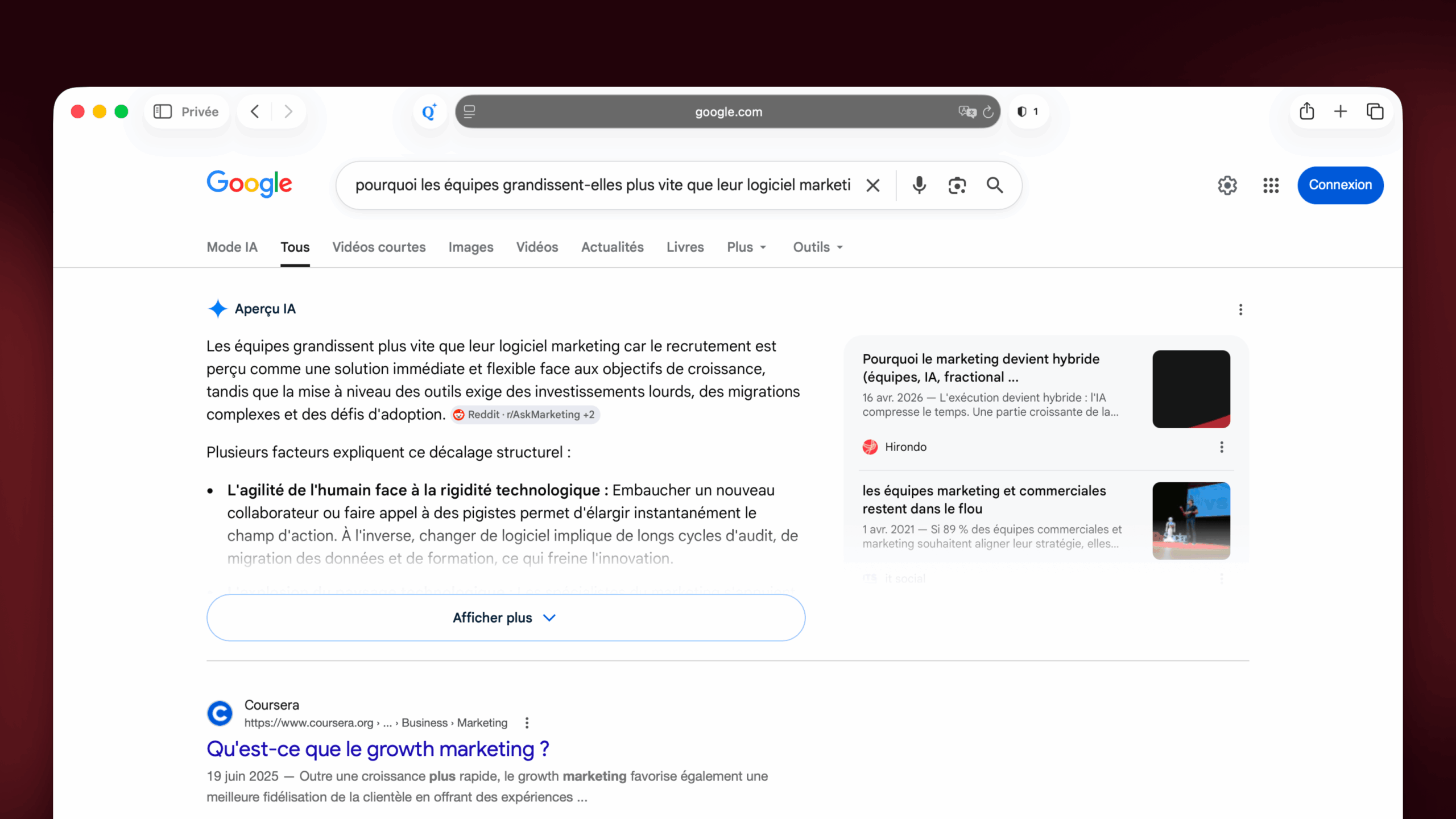
A new interface, a new behavior: the “zero‑click” era becomes the norm
AI Overviews (formerly SGE) are a feature that displays, at the top of Google, an AI‑written answer based on multiple sources, with a few links (often 3 to 5). The user promise is obvious: get a synthesis quickly, without opening lots of tabs.
The problem for businesses is just as obvious: if the answer is already there, why click?
That is the major shift: search becomes an interface for resolution, more than an interface for navigation. And in a resolution interface, traffic is no longer “given” to those who rank, but to those who are selected as sources.
In plain terms, it is not only a drop in traffic. It is a change in the nature of traffic.
The numbers that raise pressure (and why they should not paralyze you)
Trends observed in markets already exposed point in the same direction: when an AI Overview appears, clicks fall. Organic drops sharply, and even paid is affected. The results page, historically an arbitration between SEO links and ads, becomes a synthesis screen.
But there is a decisive nuance, the one that separates panic from strategy: being cited in an AI Overview can actually increase your click‑through rate compared to a situation where you are not included. And the traffic that arrives via these “assisted” environments can be more qualified, because it comes after a pre‑selection: the user has read, understood, compared, and clicks only to decide.
In other words, volume may decline, but value per visit can rise. Provided you are in the synthesis.
And that is where the question becomes a leadership question: are you a credible source on your topic, or just another player producing content “like everyone else”?
Varied contexts, one shared commitment: creating impact.
Start-ups, scale-ups, SMEs, large groups: discover how we helped them grow, structure and perform.
France: legal delay, inevitable acceleration
France is a particular case: copyright implementation and publisher compensation issues have slowed some rollouts. But two signals are hard to ignore.
First, the infrastructure is ready: French is not a barrier. Second, usage is already there: your prospects use ChatGPT, Perplexity, Gemini. They are getting used to conversational search. They want answers, not lists.
In practice, AI Overviews are not arriving in a “stable” market. They are arriving in a market where trust is fragile, where comparison is constant, where FOMO is a survival reflex. This mix makes the change both harsher and more interesting for companies that address the topic early.
The real shift: we are no longer fighting to be first. We are fighting to be chosen.
This may be the most important sentence.
Until now, much of SEO was about winning a position. With AI Overviews, you can be in position 8 and be cited, while a site in position 1 is ignored. Because the logic is no longer only “who ranks best?”, but “which source is the most reliable and the most useful to answer this question?”
SEO becomes closer to a positioning challenge than a ranking challenge.
And if that resonates, it is normal: it is the same battle you already fight in your market. Being the best option is not enough. You must be perceived as the best option. You must be chosen.
What still works: SEO, but SEO that looks like business
You read many attempts at renaming: GEO, AEO, LLMO. In practice, Google itself says it: optimizing for AI search is optimizing for the search experience. And the search experience is SEO.
The difference is not in the label. It is in the level of demand.
What works is the fundamentals, pushed to a “leadership” standard.
1) Extractable, clear, genuinely useful content.
Not an article written “to have an article.” A page that helps people understand, compare, decide. Ideas expressed without blur, with crisp definitions and logical flow. AI does not “read” like a human. It extracts. The clearer it is, the more selectable it becomes.
2) Credibility demonstrated, not declared.
E‑E‑A‑T is not a slogan. It is a mechanism: identified author, tangible expertise, updates, sources, proof. Your content must look like what it is: an asset that commits your brand. Without that, you become interchangeable.
3) Originality that cannot be copied.
This is what many underestimate. If your content repeats what everyone says, AI has no reason to cite you. What forces citation are the things only you have: field data, firsthand experience, benchmarks, methodologies, numbers, concrete cases.
4) A multi‑expertise approach.
Because SEO is no longer “a keyword story.” It is a program: technical, editorial, structuring, internal linking, positioning, measurement. And above all: decision‑making. What deserves to be written, what must be consolidated, what must be proven, what should be removed. AI accelerates, but it does not decide. We work with AI, not “AI instead of us.”
5) Deliberate diversification.
If a growing share of searches ends with no click, relying on a single channel becomes a leadership risk again. Newsletter, YouTube, LinkedIn, partnerships, distributed “reference” content, presence inside AI tools: it is not “doing more.” It is making growth less fragile.
Why this is a positioning topic (not only a traffic topic)
The companies that will suffer most are not the ones that “do SEO poorly.” They are the ones with a blurry positioning. Because AI, like users, tries to reduce uncertainty.
If your message is average, AI will compress it. If your proof is weak, AI will look elsewhere. If your expertise is impersonal, AI will cite a more credible source.
AI Overviews do not create the problem. They reveal a problem already there: the difference between a brand that “publishes content” and a brand that builds authority.
Why Hirondo (and what it looks like in practice)
At Hirondo, we treat SEO as a system, not a checklist. Because that is what this new phase requires: a backbone, not isolated optimizations.
Concretely, that means:
- diagnosing which pages must become references, not “articles,”
- an editorial strategy aligned with the real decisions your prospects make, not decontextualized keywords,
- production that mobilizes expertise, and proof, from people who have seen many cases in demanding environments,
- steering that connects content, credibility, and business performance.
It is not “making content.” It is building an advantage.
Window is short. The question is simple
AI Overviews are not a product fad. They are a change of interface. And when the interface changes, the rules of value capture change too.
So the question is not: “Is SEO going to die?”
The question is: “Are you the source people retain when they are trying to understand your market?”
If you feel your positioning needs to be strengthened, clarified, or better proven, now is probably the right time.
If you want to assess where you are vulnerable, and where you can become a reference, we can review your content and positioning in 30 minutes.