
Over the past few years, the same tension has been showing up everywhere: do more with less, and prove it.

One signal among others: Gartner reports that in 2024, marketing budgets fell to 7.7% of revenue (down from 9.1% in 2023). In other words, pressure is rising while room to maneuver is shrinking.
That is exactly when companies turn to a fractional (part-time) CMO or an interim CMO: not to stack more actions, but to restore clarity, cadence, and execution that holds over time.
What follows is the most robust method we see in the field to restructure without breaking everything and without freezing the machine for months.
Why “structuring” is becoming a need
Marketing has become more complex: more channels, an explosion of tools, constant trade-offs between short-term and long-term, and dependence on systems (CRM, tracking, content, sales enablement, lifecycle…).
As a company grows, ad hoc marketing becomes expensive. Not only in budget, but in time, attention, and trust between teams.
Here are the symptoms we see most often, and why “restructuring” comes up in almost every executive discussion.
The most common pain points
1) Too many initiatives, no priorities.
A newsletter, a webinar, a new landing page, a series of LinkedIn posts… and nothing has time to create an effect. At the end of the month, a lot happened, but no one knows what actually moved the pipeline.
2) Marketing depends on one person (or one vendor).
Strategy lives in someone’s head. Execution is scattered “task by task”. The day that person slows down, changes priorities, or leaves, the machine stops, or starts over from scratch.
3) The metrics exist, but the interpretation is missing.
Traffic, impressions, leads… with no clear link to business objectives. Result: impossible to arbitrate, impossible to say “we continue / we stop / we double down”.
4) The go-to-market moves in fits and starts.
Every quarter, a new target, a new promise, a new “idea”. On the sales side, it often translates into: “I no longer know how to explain the offer, and what we should push first.”
Structuring does not mean “adding process”. Structuring means making marketing manageable: less noise, more useful decisions.
The method to restructure without breaking the machine (in 6 steps)
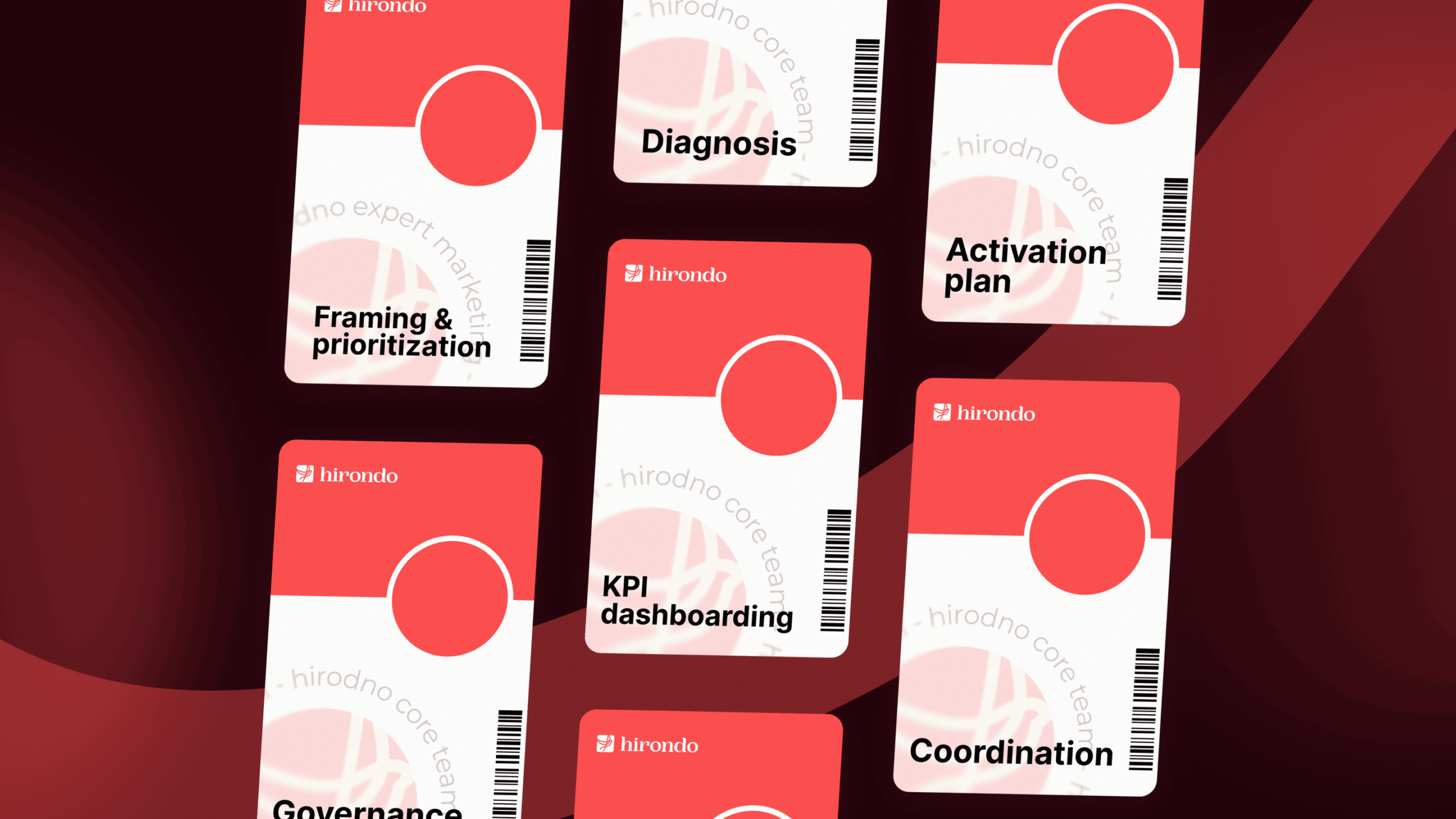
The goal is not to redo the org chart. The goal is to clarify what you are aiming for, what you stop, what you keep, and how you execute.
1) Go back to internal objectives (and make them actionable)
Before talking about tools or content, set objectives that help you make trade-offs. For example: “pipeline on a specific segment”, “activation on a use case”, “shorten the sales cycle”, “increase lead → SQL conversion rate”.
A good rule of thumb: if the objective does not change your trade-offs, it is not an objective, it is an intention.
2) Run a quick diagnosis (not a two-month audit)
A good diagnosis answers three simple questions: where is the bottleneck (message, offer, acquisition, conversion, sales cycle, activation)? What already works (and must be preserved)? What is missing to execute without constant heroics?
The trap is the “big reset”. The right reflex is to stabilize what exists, then improve it.
3) Rebuild the foundation: offer, message, priorities, responsibilities
If this foundation is not clear, everything else (campaigns, content, tools) becomes cosmetic.
Concretely, you should be able to fit on one page:
- the priority target (ICP) and the problem to solve
- the promise and proof points (the “why you”)
- the offer (packaging, scope, pricing, terms)
- a maximum of 3 priorities for the next 90 days
- who decides, who executes, who validates
This is the condition to stop “doing marketing” and start building a marketing function.
4) Prepare a job description that prevents the wrong hire
Many hiring processes fail because the job description is written like an outlet: a patchwork of pain and “they will have to…”.
A useful job description clarifies instead: the company’s stage (seed, Series A/B, turnaround, international expansion), objectives at 3/6/12 months, the real scope (strategy only, management, ops…), interfaces (CEO, sales, product), and available resources (budget, tools, team, vendors).
The key point: you are not looking for “a CMO”. You are looking for the right marketing leadership for this moment.
5) Find the right fractional or interim CMO (and frame the collaboration)
The right profile is rarely visible in a single LinkedIn line. You see it in the ability to clarify and prioritize quickly, the operating method (rituals, operating model, governance), the ability to align CEO, sales, and product, and an execution mindset (not just slides).
Then performance comes from framing: a cadence, deliverables, expected decisions, and a collaboration mode that avoids ambiguity.
6) Operationalize without hiring 5 full-time employees
This is often where everything is decided: you clarified, but you do not have enough hands.
In many situations, the best sequence is not “hire right away”. It is to activate a modular team to produce the structuring assets (messaging, brand book, website and landing pages, tracking, CRM and lifecycle, sales enablement, content, acquisition), then stabilize execution.

The role of collectives in this structuring
A collective (or taskforce) secures two things: the right leadership profile, and the ability to operationalize without waiting for the “perfect team”.
At Hirondo, the idea is simple: a CMO should not move forward alone. Once objectives and foundations are in place, our members can quickly surround themselves with a team of complementary experts to set up key workstreams (brand book, rebranding, CRM, tracking, content, paid, SEO, etc.), with coherent leadership.
For a “real-world” example of go-to-market-oriented structuring, you can read: how we helped Virtual Browser

Rrestructuring means making execution simpler
Restructuring without turning everything upside down is not doing a marketing “reset”. It is putting structure where it matters so that execution becomes readable, measurable, and sustainable.
If you recognize yourself in these symptoms (too many initiatives, no priorities, difficulty proving impact, dependency on one person), get support: a Hirondo expert can help you clarify, structure, and operationalize without breaking momentum.