ChatGPT Ads: what’s coming to France (and how to get ready)
The era of advertising on artificial intelligence is now a concrete reality. As ChatGPT has become the daily companion of hundreds of millions of users, OpenAI is taking a major strategic step by opening its model to monetisation. For advertisers and marketing directors in France, a new acquisition channel is on the horizon, one that is set to shake up the traditional players in the sector. Here is a breakdown of this announced transition and the key steps to prepare for it.
1. What are ChatGPT Ads?
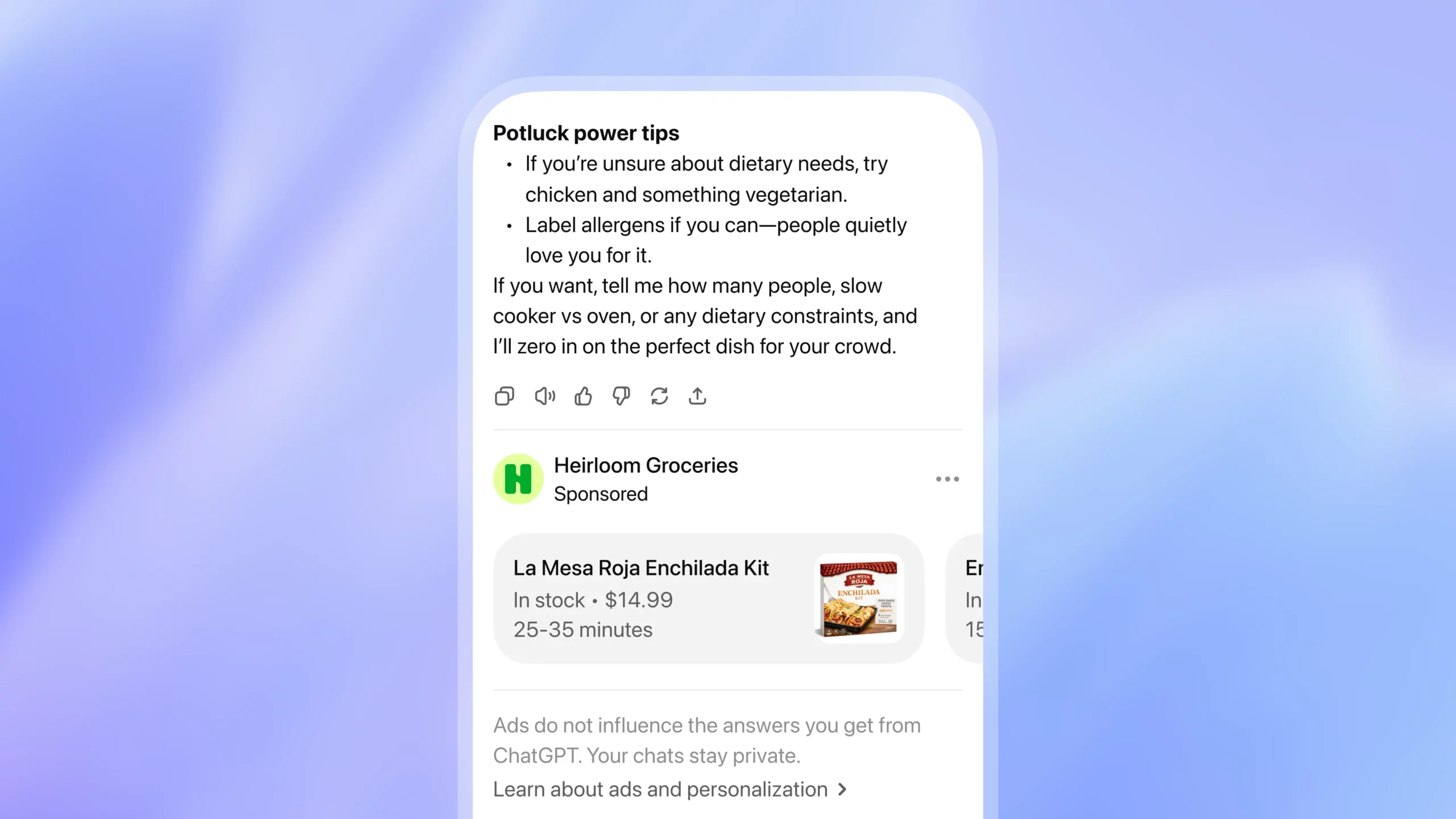
ChatGPT Ads refer to OpenAI’s initiative to monetise its conversational agent. Following a first announcement on 26 February 2026 in the United States, OpenAI officially launched advertising tests on 7 May 2026.
This commercial shift follows strict rules set by the publisher:
- Free accounts only: This format exclusively targets users of the free “Free” and “Go” tiers. Paid subscriptions (Plus, Pro, Business, Enterprise and Education) remain completely ad-free.
- A clearly labelled “Sponsored” unit: The ad appears as an insert clearly identified as sponsored. OpenAI stresses a strict separation: advertising has no influence whatsoever on the relevance or neutrality of the organic response generated by the AI.
- Targeting based on immediate intent: Unlike traditional demographic or behavioural targeting, delivery relies on the topic of the ongoing conversation, the recent conversation history, and previous interactions with ads. Advertisers have no direct access to users’ conversations, ensuring the privacy protections promoted by OpenAI.
2. How is the rollout happening (US and pilot markets)?
OpenAI’s advertising offer is being deployed progressively and methodically:
- The launch timeline: Following the United States in February 2026, the experiment expanded to Canada, Australia and New Zealand in March, then to the United Kingdom, Mexico, Brazil, Japan and South Korea in early May.
- The next wave (July 2026): According to information revealed by Digiday, Germany, France, Ireland and Singapore make up the next strategic group.
- The current format and its limits: For now, ads appear as an insert placed alongside the response. OpenAI is limiting campaigns to modest budgets to refine its selection algorithms. However, several observers already anticipate the next step: seamless ad integration woven directly into the body of the response itself (a model already tested by Perplexity).
- A massive inventory: With 900 million weekly active users claimed by ChatGPT, the vast majority of whom use the free version, the potential for visibility is enormous.
- The strong signal for France: While no official date has been communicated by OpenAI, recruitment signals are unambiguous. OpenAI has opened key positions in Europe, including a Regional Sales Manager Ads Solutions EMEA in London and a Customer Success Manager Ads Solutions based in Paris, as reported by MacGeneration on 9 July 2026.

3. What will this change for acquisition in France?
The arrival of AI advertising will profoundly reshape the digital acquisition landscape in France:
- The emergence of a third advertising pillar: Beyond the Google Ads and Meta Ads duopoly, conversation is becoming an autonomous conversion space.
- From keyword to conversational intent: This paradigm shift is closely linked to the emerging discipline of GEO (Generative Engine Optimization). Being visible and cited organically by conversational search engines is becoming just as crucial as buying sponsored placements.
- The first-mover opportunity: The modest starting budgets required by OpenAI represent a golden opportunity. Now is the time to experiment and test campaigns before the inevitable spike in auction prices seen historically on competing platforms.
- France, a highly strategic market: By targeting France, Germany, the United Kingdom and Ireland, OpenAI is addressing more than 62% of the European advertising market. This is not a simple regional extension but a highly strategic launch.
4. The arrival in France: timeline and early signals to watch
In the absence of an official calendar from the publisher, the responsiveness of French companies depends on active monitoring of early signals:
- Recruitment in Paris: The opening of applications for advertising-focused commercial profiles in Paris confirms the imminent opening of the French market.
- The expected sequence: Following the model of previous phases, expect a restricted test phase with selected pilot brands, followed by a gradual opening to mid-sized budgets.
- Channels to monitor: Keep a close eye on the official OpenAI blog, feedback from the first English-speaking advertisers, and specialist analysis from Digiday.
5. How to prepare (with Hirondo)
Anticipating this conversational revolution is the best way to turn it into a major growth lever. At Hirondo, we believe that preparation goes beyond buying ad space — it requires a global synergy between organic conversational referencing and paid campaigns.
We recommend structuring your preparation in two steps:
- Carry out a diagnostic with an expert: Assess the ability of your content and data to be read, understood and extracted by AI models. Our expertise in operational marketing leadership helps you structure this transition.
- Launch a full GEO audit: Before even purchasing your first ChatGPT Ads, make sure your brand is already cited and recommended organically in ChatGPT’s responses. To learn more about optimising your conversational conversions, discover our strategic support solutions.
Freelance,
but never alone
A marketing centre of excellence where freelancers grow together, share, learn and contribute to every mission.
FAQ: everything you need to know about ChatGPT Ads
What are ChatGPT Ads?
ChatGPT Ads is OpenAI’s new advertising programme that allows sponsored inserts to be served to users of the free versions of ChatGPT.
When will ChatGPT advertising launch in France?
No official date has been announced, but the opening of dedicated recruitment positions in Paris in July 2026 indicates an imminent launch on the French market.
What is the difference between SEO and GEO (Generative Engine Optimization)?
SEO aims to rank a website on traditional search engines like Google. GEO (or AEO) seeks to optimise content so that it is directly cited and used by generative AIs such as ChatGPT or Perplexity.
How do I work with an AI advertising agency?
An AI advertising agency like Hirondo helps you audit your content to make it exploitable by LLMs, structure your conversational campaigns, and optimise your pilot budgets from the moment new platforms open.
Get ahead with Hirondo
The shift towards AI advertising is not merely a technical evolution, it is a cultural transformation of acquisition.
Talk to our collective about growing your business today to plan your diagnostic and gain a head start on your competitors.
Varied contexts, one shared commitment: creating impact.
Start-ups, scale-ups, SMEs, large groups: discover how we helped them grow, structure and perform.