
A fractional CMO is an experienced marketing executive who works with a company on a part-time or defined-term basis, taking ownership of marketing decisions and strategy rather than individual deliverables
For startups that need senior marketing leadership today but are not yet ready to commit to a full-time executive hire, it is one of the few models that offers both strategic accountability and genuine flexibility.
This article explains when the model makes sense, what the role actually covers, how an engagement unfolds in practice, and what to look for when choosing the right person.
What is a fractional CMO?
A fractional CMO is a senior marketing leader who brings executive-level accountability to a company without a full-time contract. The title is sometimes used interchangeably with “interim CMO,” “part-time CMO,” or “outsourced marketing leadership,” but the distinctions are worth understanding.
A fractional engagement is ongoing and defined in scope, typically one to three days per week, with the CMO holding genuine strategic ownership. An interim role is usually a full-time, temporary replacement while a permanent hire is recruited. A part-time arrangement simply describes reduced hours and says nothing about the seniority or accountability of the person filling it. Outsourced marketing means execution is delegated to an external party, without strategic responsibility staying inside the business.
A fractional CMO is not a consultant who submits a report and disappears. They sit in leadership meetings, make decisions, and are accountable for outcomes within the agreed scope and time commitment.
When does a startup need a fractional CMO?
Not every startup does. The model becomes relevant at a specific inflection point: when a company has the resources to execute marketing activity but lacks the senior judgment to direct it.
This typically looks like a team producing content, campaigns, and social media posts without being able to explain how any of it connects to pipeline or revenue. Or a founder who is still the de facto head of marketing, fielding every positioning question and approving every message, while the business needs them focused elsewhere. Or a company preparing a launch, a repositioning, or a move into a new market that requires a level of strategic thinking the current team cannot yet provide.
If a startup has fewer than ten people and marketing is still an experiment, a fractional CMO is probably premature. If there is already an execution team working hard without a shared strategy, and that absence is starting to cost the company qualified conversations, it is time to consider it seriously.
”"At some point, we completely questioned our identity, and we needed different types of expertise, especially senior marketing skills that we didn't have in-house."
Maxime PerrinHead of Platform
What does a fractional CMO do?
The role is organised around decisions and outcomes. The first task is always diagnosis: understanding the market, the customer, the competitive position, and where the current funnel breaks down. From there, a fractional CMO sets the strategy, the budget logic, the channel priorities, and the measurement model that will guide the team for the next 90 days.
That strategy then becomes an operating plan with named owners and timelines. The fractional CMO aligns the internal specialists and any external agencies or partners around those shared priorities, ensuring the people doing the work understand why they are doing it. Throughout the engagement, they coach the team and gradually transfer ownership, so the business grows its own marketing capability rather than depending on an external presence indefinitely.
The output of this work is not a presentation. It is a functioning system the company can use and build on.

Fractional CMO vs full-time CMO, agency, or consultant
| Model | Strategic ownership | Speed to start | Flexibility | Internal integration | Best fit |
|---|---|---|---|---|---|
| Hirondo fractional CMO | Full ownership, defined scope | Fast — days, not months | High — adapts to stage and need | Works inside the leadership team | Startup needing senior leadership now, without a permanent hire |
| Full-time CMO | Full ownership | Slow — recruitment takes 3 to 6 months | Low — fixed contract | Full integration | Company ready to commit to a permanent executive role |
| Marketing agency | Execution, not strategy | Fast | Medium | Usually external | Defined execution tasks with internal strategic direction already in place |
| Independent consultant | Advisory or project-based | Fast | High | Usually external | Specific expertise for a defined problem or audit |
Choose a fractional CMO when the company needs executive-level marketing decisions and genuine accountability now, but the long-term shape or economics of a full-time executive role are not yet settled.
Agencies and consultants are not substitutes for each other, nor for senior strategic leadership. A capable agency executing without clear direction produces activity, not results. A consultant identifies problems without owning their resolution. A fractional CMO does both.
How a fractional CMO engagement works
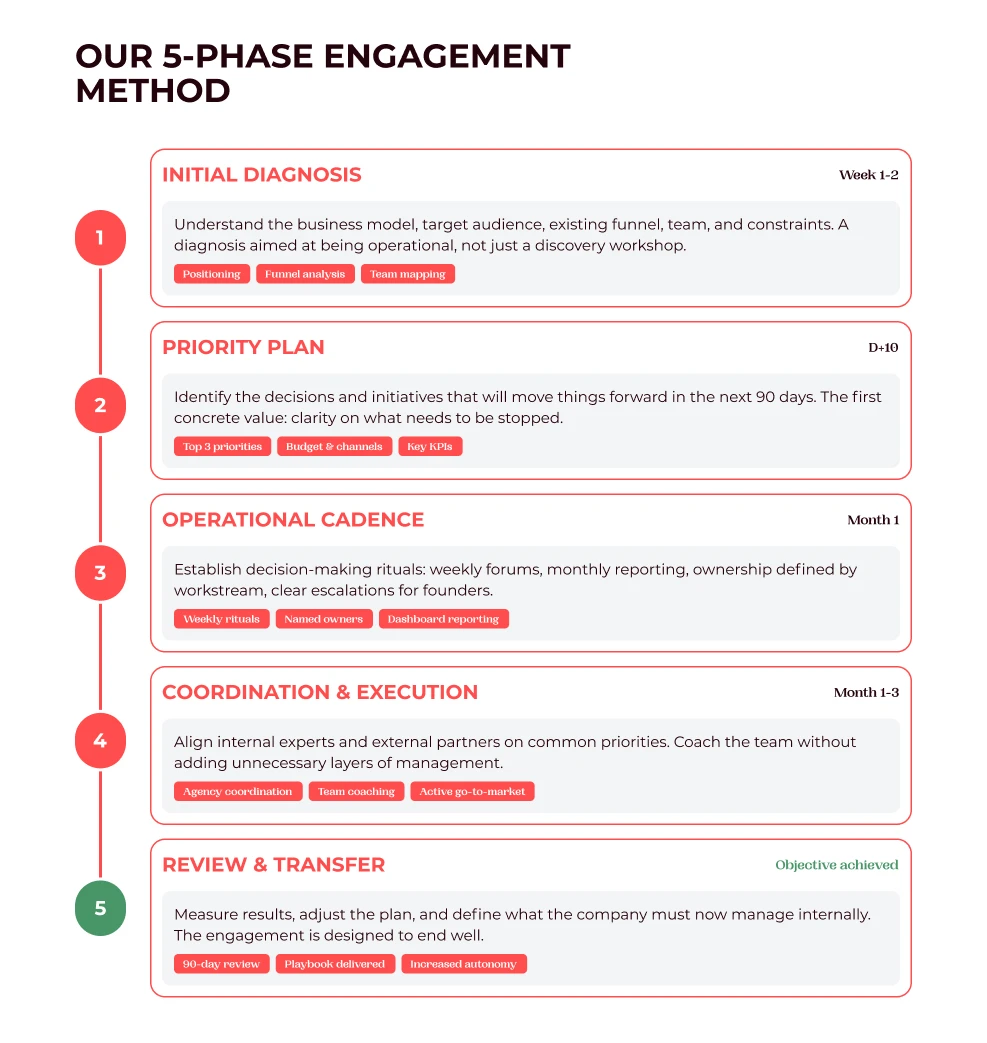
Every engagement follows roughly the same arc, even if the specifics differ by company.
It begins with an initial assessment: understanding the business model, the growth target, the customer, the funnel, the team structure, and the constraints. This is a working diagnosis, not a discovery workshop. Its purpose is to produce decisions, not observations.
The output of that assessment is a priority plan: a short list of the decisions and initiatives that matter most in the next 90 days. Most startups arrive at this conversation with too many priorities. The first concrete value a fractional CMO provides is often clarity about what to stop.
From there, the engagement establishes an operating cadence: weekly decision forums, monthly reporting, defined ownership for each workstream, and clear escalation paths for the founding team. Once the system is running, the fractional CMO coordinates the right internal and external specialists around the agreed priorities, without adding a layer of management complexity.
The engagement concludes with a structured review and transition. Progress is measured, the plan is adjusted where needed, and the company defines what it should own permanently going forward.
Varied contexts, one shared commitment: creating impact.
Start-ups, scale-ups, SMEs, large groups: discover how we helped them grow, structure and perform.
How much does a fractional CMO cost?
The cost depends on the scope, and the scope depends on the context. There is no standard rate worth publishing without understanding the situation first.
The main variables are the company’s stage and strategic complexity, the number of days per week the engagement requires, the size and structure of the existing team, and whether execution coordination is included alongside pure strategy. An early-stage startup preparing its first go-to-market plan has different needs from a Series B company managing a multi-channel demand generation programme.
The right question to ask before discussing numbers is: what decisions need to be made, who will own them, and what does success look like in 90 days? A conversation with Hirondo can answer those questions before any proposal is on the table.

Freelance,
but never alone
A marketing centre of excellence where freelancers grow together, share, learn and contribute to every mission.
How to choose a fractional CMO
Not every fractional CMO is the right fit for every company. Before committing to an engagement, it is worth assessing a few things directly.
Start with relevant experience. A strong B2C growth marketer may have little to offer a B2B SaaS company navigating a long sales cycle, and vice versa. The stage of the company matters as much as the sector.
Ask for a clear view of the first 30, 60, and 90 days. A candidate who cannot describe how they would approach the first month without additional information is telling you something important. The same applies to evidence of past decisions and their outcomes: ask for specific examples of a repositioning, a funnel correction, or a channel shift, and what happened as a result.
Finally, assess whether the proposed working model fits the existing team rather than replacing it. The best fractional CMOs improve the quality of decisions across the organisation. The engagement should have a defined structure from day one, including a clear picture of what handover looks like when it ends.
Why Hirondo
Hirondo is a senior marketing consultancy that combines strategic direction with the ability to coordinate execution. The team is built around experienced marketing leaders who have worked alongside founders, CEOs, and boards across a range of company stages and sectors. That collective experience is the foundation of marketing leadership support that produces measurable outcomes rather than activity reports.
Three principles define how Hirondo approaches every engagement. First, strategy precedes execution: the work begins with a rigorous diagnosis of the market, the customer, and the funnel before any campaign is considered. Second, the fractional CMO owns the quality of marketing judgment and the operating system, not a list of deliverables. Third, every engagement is designed to end well, with the company holding the priorities, the measurement model, and the capability the fractional CMO helped build.
Hirondo is a strong fit for companies developing a startup digital marketing strategy from the ground up, or for those in technology sectors where deep market knowledge is a prerequisite. For Hirondo’s specific track record with technology businesses, see the TechMarketing Leaders programme. For SMEs seeking external marketing leadership, the French-language service page covers the local context in detail.
It is not the right choice when the primary need is content production, paid media execution, or a part-time account manager.
Ready to assess whether a fractional CMO is the right fit?
Book a 30-minute conversation with Hirondo to review your current marketing leadership gap, the decisions that need to be made in the next 90 days, and whether a fractional CMO engagement is suited to your stage and context.
Frequently asked questions
What is a fractional CMO?
A fractional CMO is a senior marketing executive who works with a company on a part-time or defined-term basis, taking ownership of marketing strategy and decisions without a full-time contract. The engagement is structured around outcomes and leadership accountability, not individual deliverables or activities.
Is a fractional CMO worth it for an early-stage startup?
It depends on the specific gap. If the founding team still has the capacity and credibility to own marketing decisions, and the business is still validating product-market fit, a fractional CMO may not yet be necessary. Once a startup has a repeatable offer, early commercial traction, and a team running execution without senior strategic direction, the model creates tangible value.
What is the difference between a fractional CMO and a marketing agency?
An agency executes defined marketing tasks. A fractional CMO owns the strategy that determines which tasks matter and how success is measured. A fractional CMO typically decides which agencies to engage, how to brief them, and how to assess their output.
How long should a startup work with a fractional CMO?
Most engagements run between three and twelve months, depending on the complexity of the marketing challenge and the pace at which internal capability develops. The engagement should have a defined outcome and a clear transition plan, not an open-ended mandate.
Can a fractional CMO work with an existing marketing team?
Yes, and this is often the highest-value scenario. A fractional CMO provides the senior strategic direction that an experienced execution team needs to work effectively, without replacing any existing role. The best engagements raise the quality of decisions across the entire team.